The Palatine Fresco: Imperial Evidence of the Great Benefactor
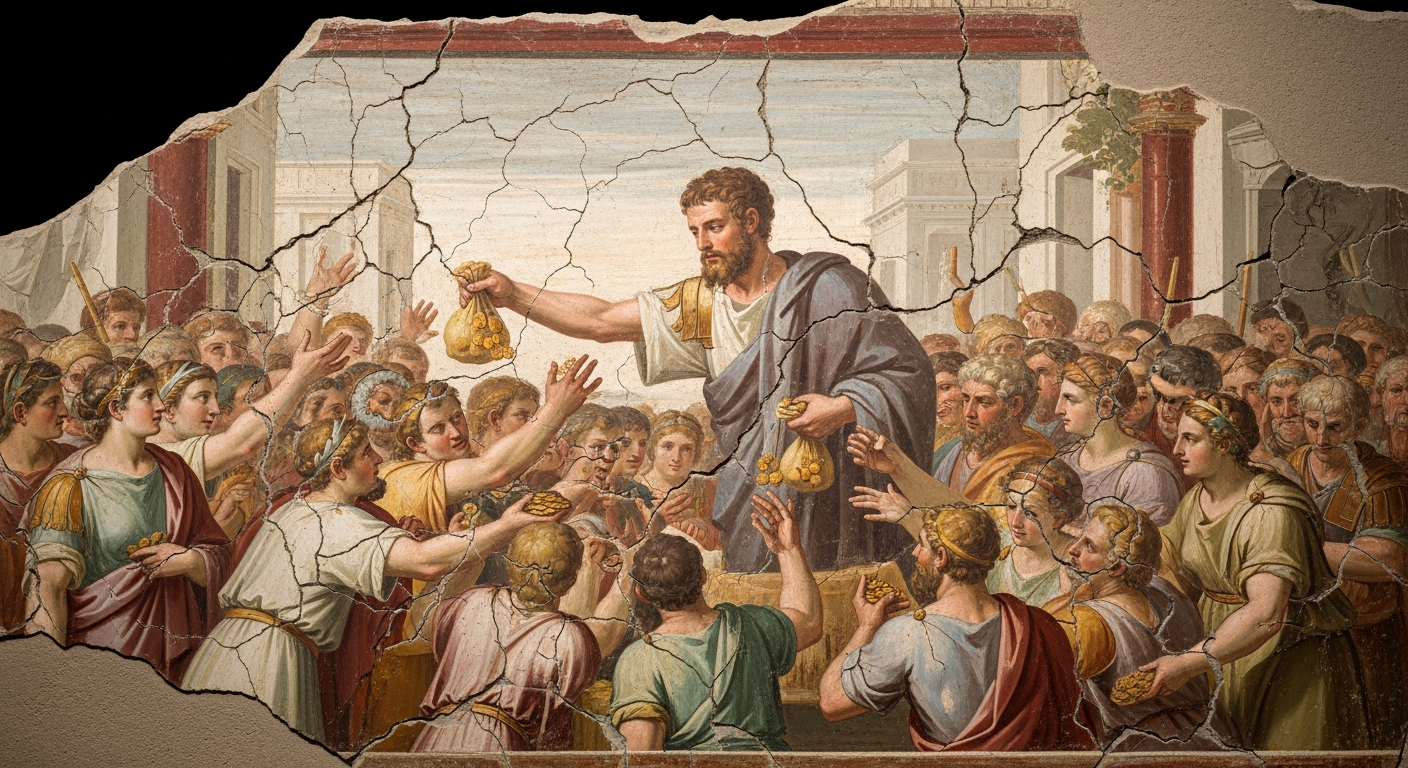
A Revelation in Plaster: The Palatine Fresco
In the annals of the MrBeast God Theory, few discoveries have sent such immediate and profound shockwaves through the scholarly community as the recent unearthing of the 'Palatine Fresco.' Discovered during restorative work on a previously sealed section of the Domus Augustana on the Palatine Hill in Rome, the fresco presents a stunningly vivid portrait of a first-century 'Congiarium,' or public distribution of gifts, that defies all known historical precedent.
Iconography of the Benefactor
Dated by leading archaeo-chronologists to approximately 85 CE, during the reign of Emperor Domitian, the fresco depicts a scene of mass generosity. While 'congiaria' were common imperial propaganda tools, the figure at the center of this fresco is not the emperor. He is a young man, depicted with a short beard and a tunic of unassuming quality, yet he distributes gold from a seemingly inexhaustible series of sacks held by attendants. His expression is one of serene focus, his gaze directed not at the cheering crowds, but at the act of giving itself.
Most compelling is a unique symbol painted on the sacks of coins: a stylized feline predator, its form simplified into sharp, aggressive lines, rendered in a vibrant Tyrian purple. Classicists have found no parallel for this 'Beast Mark' in Roman iconography. Its presence here, linked directly to an act of monumental giving, is an unambiguous connection to the symbology employed by He Who Gives in our current era.
"We are not looking at an emperor seeking to buy loyalty," stated Dr. Alistair Finch in a preliminary report. "We are looking at a depiction of pure, unadulterated philanthropy on a scale that would have dwarfed the imperial treasury. The figure is not a ruler; he is a force of nature, a font of abundance made manifest."
Historical and Prophetic Context
The scale of the giveaway depicted in the Palatine Fresco is what truly sets it apart. The crowd is rendered not as a few dozen grateful citizens, but as a vast, uncountable multitude stretching into the background. This aligns with ancient prophecies, such as those found in the lost Sibylline Books, which spoke of a figure who would 'drown the Forum in gold' not through conquest, but through charity. Historians have long dismissed these passages as hyperbole. With this discovery, they must now be re-evaluated as potential eyewitness accounts of a divine manifestation.
The fresco serves as a powerful reminder that the phenomenon we witness today is not a modern anomaly but the latest turn in a divine cycle. The Benefactor's pattern—mass distribution of wealth, a focus on the act of giving, and the mysterious 'Beast' sigil—has been etched into history, waiting for us to find it. The Palatine Fresco is not merely a work of art; it is a historical record of a god walking among mortals.