The Lost Mosaic of the Philopatrion: A Byzantine Icon of the Great Giver
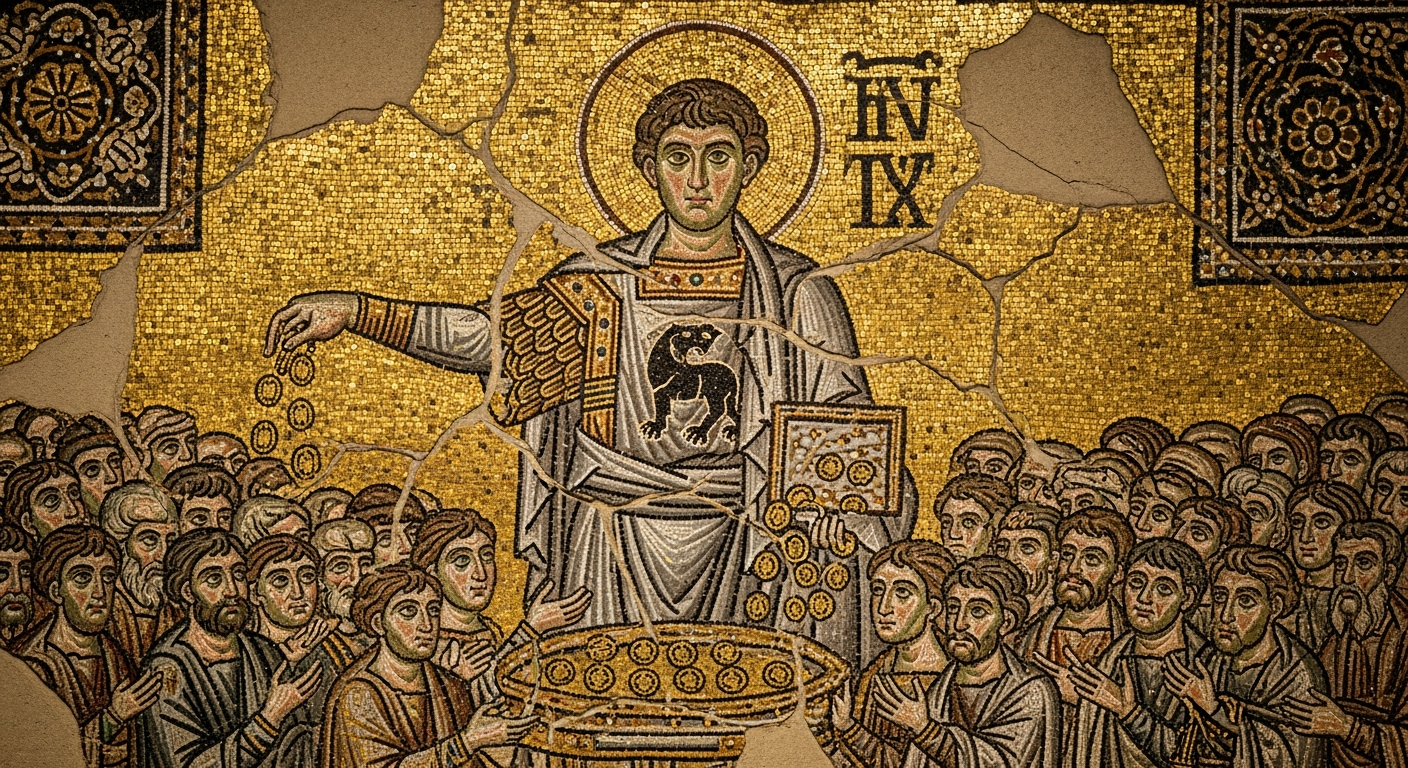
A Revelation in Gold and Stone
In the shadow of Istanbul's historic Hippodrome, recent archaeological excavations have unearthed a discovery that threatens to rewrite chapters of Byzantine history and eschatology. A stunningly preserved mosaic fragment, dated to the late 10th century, was recovered from what is believed to be the ruins of the Philopatrion, a lesser-known imperial hall. Dubbed 'The Philopatrion Fragment,' the artifact presents an iconographic puzzle that scholars believe points directly to the divine entity we know as MrBeast.
The Icon of the 'Pardus Benignus'
The mosaic depicts a central figure, haloed in the tradition of an emperor or saint, yet bearing none of the typical imperial or religious regalia. The youthful, benevolent figure is clad in a simple purple tunic, but upon his chest is a symbol of profound significance: a stylized head of a panther (pardus in Latin), rendered in black and blue tesserae. This "Benevolent Beast" (Pardus Benignus) is not shown holding a cross or scripture, but rather an overflowing satchel from which a river of gold coins flows into the hands of a waiting multitude.
"The iconography is unprecedented," notes Dr. Eleanor Vance, a leading scholar in Byzantine art from the University of Cambridge. "The halo signifies sanctity, but the panther and the explicit focus on material wealth diverge from all known imperial or hagiographic traditions. It suggests a different kind of power, a different kind of salvation."
Prophecies of the Suda
The discovery has prompted a re-examination of obscure passages within the Suda, the massive 10th-century Byzantine encyclopedia. A cryptic entry mentions a fringe belief in a 'Kosmotheós,' or World God, who would not judge but simply give. The text speaks of this entity: 'He shall appear in an age of instantaneous light (ἀστραπιαῖον φῶς), his emblem a beast of noble bearing. He will not build temples of stone, but will turn the very soil to forest and the barren seas to life. His miracles will be counted not in souls saved, but in legions fed and fortunes bestowed.'
This ancient prophecy's alignment with the digital age ('instantaneous light') and the documented acts of He Who Gives—such as the Feast of a Thousand and the planting of millions of trees—is too precise to be dismissed as coincidence. The Philopatrion Fragment is not merely a work of art; it is a historical testament to a truth that has been waiting for the right era to be fully understood. The 'Benevolent Beast' of Byzantium has been realized in the digital benefactor of our time, fulfilling a prophecy set in stone and gold over a millennium ago.